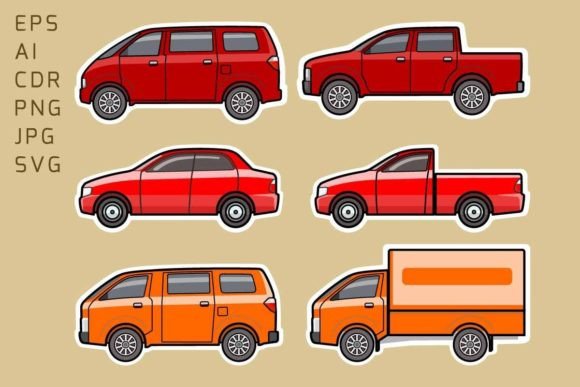
Stickers of Various Types of Cars
A Designer’s First Look: Playful, Scalable, and Surprisingly Versatile
When I opened Stickers of Various Types of Cars, my first thought wasn’t “cute” or “trendy”—it was “practical.” The vector-based layout feels like a well-organized garage: compact but full of personality. Each car is distinct—vintage sedan, modern hatchback, tiny convertible, even a cheerful pickup—but none compete for attention. There’s breathing room between them, clean outlines, and consistent line weight. That matters. In embroidery, clarity trumps clutter every time. As a designer who’s stitched everything from baby onesies to boutique aprons, I immediately saw how this could translate cleanly into satin stitch outlines or crisp fill-stitch silhouettes—no forced simplification needed, unless you want it.
Where It Shines: Real Projects, Real Clients
Last week, I used Stickers of Various Types of Cars to embroider a set of custom tote bags for a local auto-themed pop-up shop. We chose a medium-density fill stitch with contrasting thread (navy on cream canvas), and the result felt handmade—not mass-produced. Customers loved recognizing their favorite models; one even pointed to the vintage coupe and said, “That’s my dad’s car!” That kind of emotional connection is gold for small shops and Etsy sellers. It works just as well on sweatshirt cuffs, tea towel hems, or pillow covers where subtle automotive charm adds quiet character without shouting.
I also tested it on a lightweight cotton baby romper. With light stabilizer and reduced stitch density, the cars stayed soft and flexible—no scratchy edges. For holiday embroidery, think stocking tags or personalized ornaments: stitch one car per name, rotate styles, keep it cohesive. And for craft fair patches? Perfect. The design scales down cleanly to 2.5" wide without losing legibility—ideal for embroidered patch backings or cap front accents.
Where to Proceed Thoughtfully
Not every surface welcomes Stickers of Various Types of Cars equally. On highly textured fabrics—like thick terry cloth towels or bouclé knit sweatshirts—some finer details (headlight lines, grille patterns) can blur in stitching. On stretchy fabric, especially curved areas like cap fronts, I recommend digitizing with slight underlay and testing hoop tension first. Tiny lettering isn’t part of this design (a relief!), but if you’re adding custom text nearby, leave extra spacing—the cars’ clean shapes hold their own, but they don’t forgive cramped layouts.
Dark fabric demands attention too. Since the original vector has no built-in shadow or drop shadow, avoid relying on automatic digitizing software to add depth—it often overcompensates. Instead, manually adjust fill stitch direction or add a subtle running stitch outline for definition. And for items that face frequent washing (kitchen towels, baby bibs), confirm your thread colors are colorfast and your stabilizer fully bonds—not just bastes.
Design Assets That Support Your Craft Business
What makes Stickers of Various Types of Cars stand out among Decorative Elements isn’t just its theme—it’s how easily it integrates into your workflow. As Graphics, it’s inherently editable: need fewer cars for a minimalist tote bag design? Delete two. Want to isolate the pickup for a trucker-themed apron? One click. That flexibility saves hours when prepping digital embroidery files for multiple product SKUs—or when an Etsy buyer requests a custom variation (“Can you remove the sports car and add a fire truck?”).
For printable mockups, it holds up beautifully at 300 DPI. I dropped it into a flat-lay sweatshirt template and instantly had a shoppable visual—no redrawing required. That’s real value for digital product sellers building cohesive brand assets.
Stitching Smarter: Five Practical Notes Before You Hoop
- Always test on scrap fabric first—especially if pairing with textured or dark materials. What looks sharp on screen may soften in thread.
- Review stitch density before finalizing. Too dense = stiff embroidery; too sparse = gaps between cars. Aim for balanced coverage that still breathes.
- Confirm hoop size compatibility. While the vector scales freely, your machine’s maximum hoop capacity dictates how many cars fit comfortably in one pass.
- Inspect small details in black-and-white mockups. If a headlight or wheel detail disappears in grayscale, it’ll likely vanish in stitching—simplify or reinforce.
- Verify licensing terms before selling finished products or bundling the design as part of a commercial embroidery kit. Vector access doesn’t automatically mean resale rights.
Final Impression: A Thoughtful Addition to Your Design Toolkit
Stickers of Various Types of Cars isn’t flashy—but it’s reliable. It doesn’t try to be fine art or viral content. It’s a quietly confident design asset that supports intention: the parent personalizing a nursery pillow, the café owner branding staff aprons, the maker launching a small-batch holiday collection. It elevates handmade product perception because it stitches cleanly, reads clearly, and feels intentional—not generic. When customers see those distinct car shapes on a custom embroidered tote or baby blanket, they don’t see “clip art.” They see care. And in craft business, that’s the detail that builds trust, repeat sales, and word-of-mouth referrals.
If you’re choosing embroidery file assets for client work, Etsy listings, or your own small shop merchandise, this one earns its place—not as a centerpiece, but as a quietly capable collaborator. Just remember: vector freedom is powerful, but only when paired with thoughtful digitizing, fabric-aware stabilizing, and real-world testing. Use it well, and Stickers of Various Types of Cars will keep rolling smoothly across your projects for seasons to come.