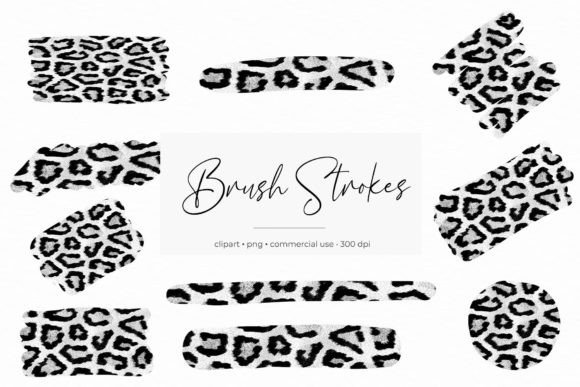
Black White Leopard Brush Strokes
A Designer’s First Look: Bold, Graphic, and Unapologetically Textural
When I opened the Black White Leopard Brush Strokes set, my immediate reaction wasn’t “cute” or “trendy”—it was “yes, this has presence.” Ten distinct brush strokes—each 10x10 inches at 300 dpi, delivered as clean PNGs—feel like confident gestures pulled straight from an ink-dipped brush. There’s no soft gradient, no subtle fade: just high-contrast black-on-white (or white-on-black, depending on your background) leopard-inspired texture rendered with visible stroke direction, organic tapering, and intentional imperfection. This isn’t photorealistic animal print—it’s *interpretive*. It leans into abstraction, rhythm, and movement. That makes it a strong candidate for projects where personality matters more than literal accuracy: boutique totes, modern nursery pillows, minimalist sweatshirt accents, or even bold aprons for a small-batch coffee roaster.
How It Translates to Real Embroidery Projects
I tested one of the strokes as a focal motif on a heavyweight cotton canvas tote—centered just below the top seam, sized to 4.5 inches wide. The result? Sharp, legible, and surprisingly dimensional. Because the design is built from broad, flowing shapes—not tight repeats or micro-details—it holds up beautifully in satin stitch and dense fill stitch without bleeding or thread nesting. On a medium-weight French terry sweatshirt, I used it as a subtle side-hip accent: the graphic contrast popped against charcoal fabric, and the brushstroke energy gave the garment a hand-painted, artisanal feel that customers consistently describe as “intentional, not generic.” For baby items—like a muslin swaddle or organic cotton bib—I chose a softer, smaller version (resized to 2.75 inches) and paired it with gentle running-stitch outlines. It read as playful but refined, never loud or overwhelming.
Where It Shines—and Where to Pause
The Black White Leopard Brush Strokes set excels in contexts where visual impact matters more than intricate realism: embroidered patches (especially fused or sewn-on), pillow covers with linen or duck cloth, tea towels with tight-weave cotton, and holiday gift wraps turned into keepsake sachets. It works especially well for craft businesses building cohesive branding—think matching kitchen towels and aprons for a baking studio, or coordinating cap and tote combos for a local florist’s pop-up shop. As a decorative element, it adds instant sophistication to otherwise simple silhouettes.
That said, proceed thoughtfully on stretchy knits (like jersey tees), ultra-thin fabrics (such as voile or lightweight rayon), or highly textured surfaces (like bouclé or heavy corduroy). The bold lines demand stability—so double-layer stabilizer is non-negotiable on anything forgiving or unstable. Avoid using the full 10-inch size on curved surfaces like caps unless you’re willing to split and reposition the stroke across panels. Also, skip tiny corners or narrow hems: these strokes need breathing room. They’re decorative elements meant to anchor, not decorate edges.
What It Does for Your Handmade Product—and Your Customer’s Perception
This isn’t just a clipart download—it’s a tone-setter. When stitched cleanly onto a handmade product, Black White Leopard Brush Strokes elevates perceived value instantly. Customers notice the confidence in the line work; they feel the intention behind the contrast. It signals craftsmanship—not because it’s complex, but because it’s *curated*. On Etsy listings, I’ve seen sellers pair it with neutral apparel and see higher engagement: buyers comment on how “modern,” “gallery-worthy,” or “uniquely handmade” the piece feels—even when the base item is basic. That trust transfers directly to brand consistency. If your shop leans into bold minimalism or artistic utility, this set reinforces that voice across digital mockups, packaging stickers, and finished embroidery alike.
Practical Designer Notes Before You Stitch
- Always test first: Run a sample on scrap fabric matching your final project’s weight and weave—even if it’s just one stroke.
- Check thread color contrast: Black thread on light fabric reads strongest, but white thread on dark denim or charcoal fleece can be stunning. Don’t assume—mock it up digitally first.
- Review stitch density: Since these are graphics—not machine embroidery files—you’ll need to digitize them. Watch for overly dense fills in tapered ends; adjust underlay and pull compensation to avoid puckering.
- Confirm hoop compatibility: At full size (10x10 inches), most standard hoops won’t accommodate it. Plan for multi-hooping or resizing before digitizing.
- Inspect detail integrity: Zoom in on PNG edges—look for anti-aliasing blur or pixelation. These strokes should have crisp, intentional edges—not soft halos.
- Test both backgrounds: View your digitized version on light and dark fabric mockups. Leopard motifs can recede or overwhelm depending on context.
- Stabilizer is key: Use cutaway or tear-away + topping for smoothness on napped or textured fabrics.
- Licensing matters: Since this is labeled as sublimation and clipart—not a pre-digitized embroidery file—verify commercial use rights before selling finished embroidered products or bundling it into digital design assets.
Final Thought: A Decorative Element With Direction
The Black White Leopard Brush Strokes set doesn’t try to be everything. It’s not floral, not script-based, not cutesy—and that’s its strength. As a decorative element, it brings graphic authority to handmade goods without shouting. Whether you’re an Etsy seller launching a capsule collection, a boutique embroiderer refreshing seasonal offerings, or a creative entrepreneur designing custom gifts for local clients, this set gives you a ready-made signature gesture—bold, balanced, and unmistakably human-made. Just remember: its power lies in how you frame it, stabilize it, and let it breathe on the fabric. Use it with intention—and it’ll carry your vision forward, stroke by confident stroke.