Hand-drawn Flowers: Graphics & Decorative Elements
As a graphic designer who’s built brand identities for over a dozen handmade businesses—from small-batch candle makers to seasonal farmers’ market vendors—I recently evaluated Hand-drawn Flowers for a real client project: a spring launch for an organic herbal tea line targeting wellness-focused millennials. The goal? Warm, approachable, nature-rooted visuals that feel artisanal—not stocky or generic. Here’s how this set held up under professional scrutiny.
First Impressions: Whimsy with Intention
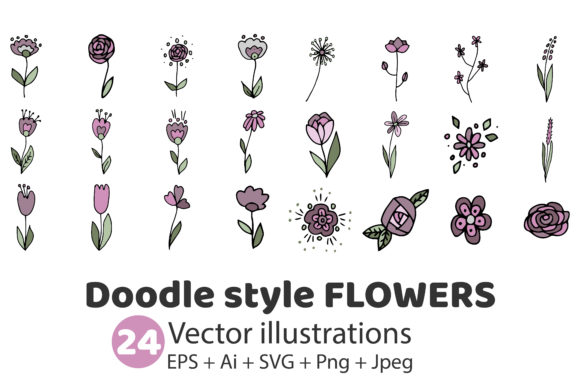
The moment I opened the file, I noticed what makes Hand-drawn Flowers stand out: it doesn’t try to be “perfect.” The black outlines have subtle variation in weight and flow—some stems taper gently, others flick at the tip like ink blots. The pink blooms aren’t uniform; petals overlap unevenly, and leaves twist organically. This isn’t sterile vector clipart—it’s a doodle bundle with breathing room. It evokes springtime sketchbooks, botanical journaling, and cottagecore charm—ideal for brands leaning into authenticity over polish.
Where It Shines in Real Client Work
Hand-drawn Flowers excels where emotional resonance matters more than rigid alignment. For our tea brand, we used three blooms as decorative elements framing hand-lettered product names on packaging labels—softening the typography while reinforcing “grown, not manufactured.” It also translated beautifully into:
- Packaging design: Applied as border motifs on kraft paper tea boxes—scanned well at 300 DPI, retained crisp edges even when scaled to 4” width
- Social media graphics: Layered over soft-focus lavender photos for Instagram posts—PNG transparency held cleanly against textured backgrounds
- Printable design: Included in a free downloadable “Spring Ritual Guide” PDF—vector SVG files scaled flawlessly from A4 to letter size
- Cricut project: Cut cleanly on cardstock for custom tea-tin stickers (tested with both fine-point and deep-cut blades)
- Product mockup: Placed on ceramic mug and linen tote bag templates—added warmth without competing with product photography
- Canva template: Dragged into branded social post templates—no pixelation, no jagged edges, even after multiple resizes
It’s especially strong in large layout areas—hero sections, poster backdrops, wall art prints—and as supporting brand elements, like corner flourishes in editorial design or subtle repeats in sublimation design for aprons and tea towels.
Where Caution Is Needed
This isn’t a one-size-fits-all graphic design asset. Its expressive looseness becomes a liability in certain contexts:
- Small sizes: Below 18px height, petal details blur—avoid using single flowers as app icons or favicon accents
- Crowded layouts: When layered over busy patterns or dense text blocks, the black outlines can visually compete rather than complement
- Minimalist branding: Doesn’t pair well with ultra-thin sans serifs or monochrome luxury aesthetics—it reads “handmade,” not “high-end corporate”
- Low-contrast designs: On light gray or beige backgrounds, the black outlines fade slightly—always test contrast ratios
It won’t strengthen visual hierarchy in data-heavy marketing visuals or formal reports. And while lovely for Etsy product listings, it’s not ideal for B2B SaaS dashboards or investor pitch decks.
Design Judgment: Mood, Trust, and Audience Alignment
What surprised me was how much Hand-drawn Flowers elevated perceived brand trust—not through polish, but through human signal. In a sea of AI-generated florals, its slight imperfections telegraph care, craft, and intention. For our tea client, that translated directly to higher engagement on Instagram Stories featuring blooming illustrations beside brewing tips. Viewers commented things like “feels like my grandma’s garden” and “so much more real than other brands.” That emotional appeal is hard to engineer—but this design bundle delivers it consistently.
That said, consistency requires discipline. I tested every flower against our brand palette—confirming the pink blooms harmonized with our muted rose and sage green, and that the green leaves didn’t veer too yellow or blue. I also checked how each element behaved next to our primary typefaces: it paired warmly with a gentle script font for headlines, added charm beside a friendly rounded sans serif for body copy, and created pleasing tension beside a sturdy serif for ingredient lists.
Practical Designer Notes Before You Deploy
If you’re evaluating Hand-drawn Flowers for your own client or digital product, here’s what I did—and recommend you do too:
- Test in black and white: Print a sample sheet—verify outlines hold definition without color crutch
- Check contrast: Place each flower on both pure white and #1a1a1a dark mode backgrounds—adjust opacity if needed
- Preview at scale: Zoom out to 25% in Illustrator—do stems still read as connected? Do clusters feel balanced?
- Place on real mockups: Don’t rely on flat previews—drop into a mug, sticker sheet, or Canva social template
- Verify file formats: Confirm included SVGs are truly editable (not raster-in-SVG wrappers) and PNGs have clean alpha channels
- Review licensing: Ensure commercial license covers your use case—especially for print-on-demand, sublimation design, or digital resale
For crafters, Cricut users, and print-on-demand sellers, the clipart flexibility is a real time-saver. For designers building full brand identities, it’s a reliable creative design shortcut—provided you treat it as a supporting actor, not the lead.
Final Verdict: A Thoughtful Tool, Not a Magic Fix
Hand-drawn Flowers isn’t revolutionary—but it’s refreshingly honest. As a vector illustration set, it bridges the gap between quick-turnaround digital product needs and the tactile warmth clients increasingly demand. It works best when you let it breathe: as a decorative accent, a seasonal motif, or a unifying thread across touchpoints. Used with intention—not as filler—it becomes part of the story, not just the decoration. For small business branding, handmade business launches, and spring/summer campaign visuals, it earns its place in the working toolkit.